MENU
Vishuddha – The Throat and Fifth Chakra

The Throat Chakra, known in Sanskrit as Vishuddha, is the fifth of the seven principal chakras and the first of the three upper energy centres. Traditionally associated with the colour blue, the element of ether or space (akasha), and the qualities of sound, vibration and communication, Vishuddha is often described as the centre of authentic self-expression — the place where our inner world finds its voice.
The Sanskrit word Vishuddha is commonly translated as ‘especially pure’ or ‘purification’, inviting us to consider not only the words we speak, but the intention, awareness and energy we bring to them. Our voice carries far more than information. Through its tone, rhythm, resonance and even its silences, we communicate something of our emotional landscape, our experiences and our relationship with the world around us.
Although each chakra has its own particular qualities and associations, they are traditionally understood as interconnected. Vishuddha offers a means of expressing what arises through the other energy centres — our feelings, instincts, desires, creativity, love and intuitive wisdom. It is here that what we experience inwardly may find expression through speech, song, storytelling, laughter, tears and the many other ways we communicate and share ourselves with the world.
Yet authentic expression is not simply about speaking freely or finding the courage to make ourselves heard. It also asks us to listen — to recognise what we genuinely feel, to honour the wisdom of our own experience, and to discover how we might give voice to that inner knowing in ways that are truthful, compassionate and appropriate to the moment.
There is a fascinating relationship between the Sacral and Throat Chakras, one that reaches beyond creativity and self-expression into the deeper territory of instinct, feeling and embodied awareness.
The Sacral Chakra, Svadhisthana, is traditionally associated with the element of water, our emotional world, sensuality and creative life force. Within some chakra teachings, it is also understood as a place of instinctive knowing — that quiet awareness we sometimes describe as a ‘gut feeling’. Something we sense within ourselves before we can necessarily explain it, an awareness that something feels right, or perhaps that something is not quite as it seems.
Vishuddha offers a voice to this inner experience. It is where feelings, instincts and creative impulses can begin to take form through words, sound and expression. How often have we sensed something deeply, yet struggled to articulate it? Or found ourselves agreeing with another when something within us was saying otherwise?
There can be a considerable distance between what we feel and what we allow ourselves to express. We may fear being misunderstood, judged or rejected, or have become so accustomed to meeting the expectations of others that we scarcely notice when our own voice has fallen silent.
Finding our voice is therefore not simply about speaking more confidently. It is also about recognising and honouring our own experience, developing the courage to express what matters to us, and allowing ourselves the freedom to be authentic. Sometimes that means speaking. Sometimes it means saying no. And sometimes it means allowing silence to hold what is not yet ready to be spoken.
And perhaps there is something equally important in the act of expression itself. For it is often through speaking, singing, writing or storytelling that we begin to understand more fully what we have been feeling. As we give voice to our inner world, we may discover something about ourselves that had previously remained unspoken.

Human beings are storytellers. Long before the written word, we shared our experiences, wisdom, fears and dreams through stories, songs and spoken traditions. Stories have helped us make sense of the world, connect with one another and pass knowledge from one generation to the next. They continue to shape our understanding of who we are, where we belong and what we believe is possible.
Yet how often do we stop to consider the stories we carry? Some have been handed down through our families, communities, cultures and institutions, repeated so frequently that we scarcely think to question them. Others are deeply personal — the stories we tell ourselves about our abilities, our worth, our relationships and the possibilities available to us. Some are nourishing and empowering, while others may quietly limit the way we experience ourselves and the world.
In my exploration of Friday the 13th: A Sacred Mystery – Beyond Fear and Superstition, we considered how the number thirteen came to be associated with misfortune in many Western traditions, despite its rich and varied symbolism elsewhere. It offers an interesting reminder that what we accept as familiar or unquestionable may be only one version of a much larger story.
And this is where imagination becomes such an extraordinary gift. We have the capacity to imagine beyond what we have been told, beyond the familiar boundaries of our experience, and to give expression to possibilities that have not yet taken form. Every new story, every creative endeavour, every meaningful change begins, in some way, with our ability to imagine something different.
Through Vishuddha, we might consider the power of giving voice to these possibilities. The words we choose, the stories we share and the intentions we express can influence our relationships, our choices and the ways in which we participate in the world. Our words can encourage or diminish, unite or divide, open a conversation or bring it to an end. And sometimes, speaking aloud what has long remained within us can be the beginning of bringing something new into being.
Perhaps one of the most valuable questions we can ask ourselves is not simply, ‘What is my story?’ but ‘What story am I choosing to tell, and what am I giving life to through the way I express it?’
Communication is so much more than the words we speak. It is also about our capacity to listen, to receive and to be present with what another is sharing. And yet, how often do we find ourselves preparing our response before someone has finished speaking, interpreting their words through the lens of our own experiences, beliefs and expectations?
To listen deeply asks something of us. It invites us to make space for another's experience without immediately needing to agree, disagree, advise or offer a solution. We may discover that what someone is trying to communicate lies not only in their words, but in the pauses between them, the tone of their voice, or even in what remains unspoken.
And listening begins within ourselves. In the midst of busy lives, competing demands and the constant flow of information, it can be surprisingly difficult to hear our own inner voice. We may become so accustomed to the noise around us that we lose touch with what we genuinely feel, need or wish to express. Creating moments of stillness can help us reconnect with that inner awareness, allowing our words and actions to arise from a more considered place.
Silence, too, has an important part to play. It need not be an absence of communication, nor a sign that something has been withheld. Sometimes silence offers the space in which understanding can deepen, emotions can settle and something previously unheard may finally be recognised. There is wisdom in knowing when to speak, when to listen, and when simply to remain present.
Within the symbolism of Vishuddha, associated with ether or space, this relationship between sound and silence becomes particularly evocative. Space allows room for expression, while silence invites us to notice what is already present. In a world where so much emphasis is placed upon making ourselves heard, perhaps one of the most meaningful expressions of our voice is the willingness to listen.
And when we truly listen — to ourselves, to one another and to the world around us — communication becomes something more than an exchange of words. It becomes an opportunity for connection, understanding and relationship.

Our relationships offer us countless opportunities to discover how we communicate, not only with others, but with ourselves. Through our conversations, disagreements, expressions of love and moments of misunderstanding, we may become more aware of the ways in which we use our voice — and the times when we choose not to.
The relationship between the Heart and Throat Chakras is particularly meaningful here. Anahata, the Heart Chakra, is associated with love, compassion and connection, while Vishuddha offers a means of expressing those qualities through our words and actions. When we speak from the heart, we may find it easier to communicate with kindness and understanding, even when what we need to say is difficult.
Yet authentic expression does not mean always agreeing, pleasing others or avoiding uncomfortable conversations. Sometimes it asks us to speak with courage, to express a need, to acknowledge a hurt or to establish a boundary. A loving and compassionate voice can also be a clear and unwavering one. And just as importantly, we can listen with an open heart without abandoning our own experience or understanding.
Forgiveness is another aspect of communication worth exploring. We may carry words that were spoken in anger, conversations that never took place, or feelings that have remained unexpressed for many years. These experiences can influence the stories we tell ourselves and the ways we relate to others. Finding a means of acknowledging and expressing what we have carried can sometimes help us move towards greater understanding, acceptance or forgiveness.
But forgiveness is deeply personal. It cannot be demanded or hurried, nor does it necessarily mean reconciliation, forgetting what happened or accepting behaviour that has caused harm. Sometimes the most important expression of self-respect is recognising what we are no longer willing to participate in.
Perhaps the invitation of Vishuddha is to explore how we might communicate with greater awareness — allowing our words to reflect both compassion and integrity, while recognising that our voice, our silence and our boundaries all have a place in creating relationships rooted in mutual respect.

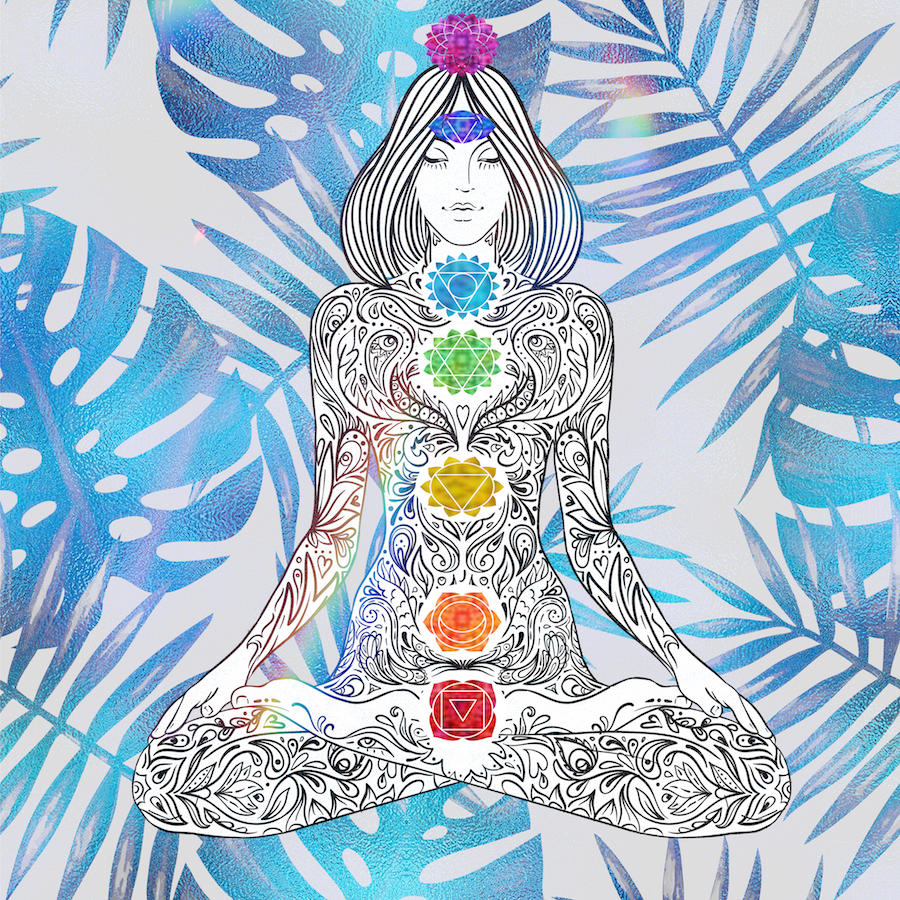
In traditional chakra imagery, Vishuddha is represented by a lotus with sixteen petals, often depicted in shades of blue or violet. At its centre is a circle symbolising akasha, the element of ether or space, while its seed mantra, HAM, is associated with the vibration of the Throat Chakra. The sixteen petals are traditionally linked with the vowels of Sanskrit, reminding us of the intimate relationship between sound, language and expression.
Within yogic and tantric traditions, the repetition of sacred sounds or mantras has long been used as a means of focusing awareness and deepening spiritual practice. Chanting HAM, singing, humming or simply allowing the voice to resonate through the body can offer an opportunity to explore our relationship with sound and expression. We need not consider ourselves singers, nor strive to produce a particular note. The invitation is simply to experience the sound of our own voice and notice how it feels.
Movement, too, can support this exploration. Gentle stretches for the neck and shoulders, mindful breathing, and yoga postures traditionally associated with Vishuddha may encourage us to become more aware of the throat, jaw and surrounding areas where we sometimes hold physical tension. As with any movement practice, comfort and ease are more important than forcing a particular posture or sensation.
Blue, the colour most commonly associated with the Throat Chakra in contemporary chakra systems, offers another symbolic connection. The vastness of an open sky, the changing colours of the sea, or the delicate blue of a flower may invite us to contemplate spaciousness, openness and freedom of expression. Some people also choose to work with crystals such as lapis lazuli, aquamarine or turquoise as personal reminders of these qualities, although their effects on chakra energy or physical health have not been scientifically established.
Yet perhaps some of the most meaningful ways of nurturing Vishuddha are also the simplest. Singing a favourite song, reading poetry aloud, writing what we have struggled to say, sharing a story, or allowing ourselves to speak with greater honesty and care can all become expressions of conscious communication. Even the decision to remain silent, when silence feels appropriate, can be an authentic choice.
Rather than seeking to make our voice louder or more powerful, we might begin by becoming more familiar with it — listening to its resonance, recognising when it feels constrained or free, and allowing it to become a more natural expression of who we are.
Sound is an intimate part of our human experience. Long before we learn to speak, we respond to rhythm, tone and vibration. Our voices carry our emotions, our songs preserve memories, and the sounds of the natural world accompany us throughout our lives. Sound can stir something within us that words alone cannot always reach.
Within the symbolism of Vishuddha, sound becomes more than a means of communication. It offers a way of exploring our relationship with ourselves and the world around us. Through singing, chanting, humming or simply listening, we may become more aware of the subtle relationship between our inner experience and what we express outwardly.
The gongs offer another dimension to this exploration. Their rich and complex tones, shifting harmonics and resonances can create an immersive listening experience, inviting us to turn our attention away from the constant demands of everyday life and towards the sensations, feelings and thoughts that arise within us. There is no particular response we need to achieve, no expectation to understand or interpret what we experience. We are simply invited to listen and receive.
And within the sounds, there are moments of silence — spaces in which we may notice the fading resonance of a gong, the rhythm of our own breathing, or the presence of something that had previously escaped our attention. Sometimes it is in these moments that we become more aware of what we have been carrying, what we long to express, or what might be asking for our attention.
Perhaps this is one of the most meaningful invitations of Vishuddha: to cultivate a relationship with our own voice while remaining open to the voices of others and the wider world. To recognise that authentic expression does not always require words, and that listening, silence and presence can be just as powerful as speech.
At Sound-Well, my gong and sound baths offer an opportunity to explore this relationship through an immersive experience of sound, vibration and stillness. Whether joining me in person or listening to a recording in your own space, you are welcome to discover what arises when you make time simply to listen.
Explore Sound-Well's Sound Baths and Events
What within you is longing to be heard, and how might you begin to give it a voice?