
MENU
Friday the 13th. For centuries, this curious combination of day and number has carried a reputation for misfortune, superstition and fear. Some avoid making important decisions, travelling or beginning anything new, whilst others simply smile at the idea that a date on the calendar could have any influence over their lives.
But what if there is another story to tell?
What if thirteen, far from being a number to fear, carries associations with the sacred rhythms of Nature, the Goddess, and the eternal dance of death and rebirth?
Exploring its place in mythology, mathematics, astronomy and ancient traditions reveals a rather different picture, inviting us to question not only what we have been taught about thirteen, but how our beliefs are shaped, and whose authority we allow to determine what is sacred, dangerous or worthy of our trust.

Our journey begins with Friday itself, a day whose origins are woven into the traditions of the Goddess. In the Roman world, Friday was dies Veneris, the day of Venus, Goddess of love, beauty, fertility and desire. The English name comes through Germanic traditions associated with Frigg, whilst Freyja, another powerful Norse Goddess, has also become closely associated with the day.
Venus herself offers us a fascinating connection with thirteen. Over approximately eight Earth years, she completes thirteen journeys around the Sun, whilst appearing to complete five cycles between her appearances as morning and evening star. These numbers, five, eight and thirteen, also belong to the Fibonacci sequence, a mathematical progression whose patterns are reflected in some of Nature's most beautiful forms.
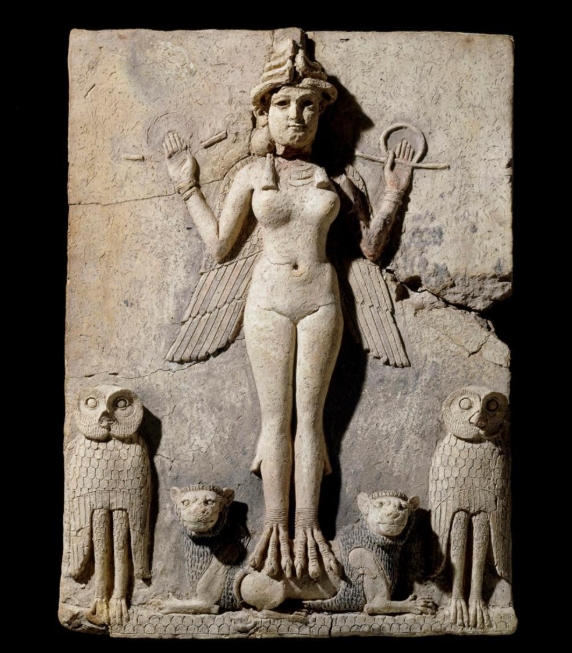
The movements of Venus have fascinated humanity for millennia. To the ancient Sumerians, the planet was associated with Inanna, Goddess of love, fertility, sexuality and war, whose extraordinary journey into the Great Below has been occupying much of my own storytelling world recently.
And it is through Inanna that we encounter another dimension of thirteen's symbolism, one that takes us beyond the familiar associations of Venus with love and beauty, into the mysteries of death, transformation and return.
In the ancient Sumerian myth, Inanna, Queen of Heaven and Earth, hears the call of the Great Below, the realm of her sister Ereshkigal. Leaving behind the world she knows, she journeys towards the Underworld, passing through seven gates, where at each she is required to surrender another piece of her royal regalia, until she stands naked before the powers of the Great Below.
There, Inanna encounters death. Her lifeless body is hung upon a hook, where she remains for three days and three nights, until the intervention of others makes her return possible. Yet her restoration to life does not undo what has happened. Her journey carries consequences, and the relationship between the worlds above and below cannot simply be set aside.
Although the ancient story does not associate Inanna's descent with the number thirteen, its themes resonate with the symbolism that thirteen has acquired through other traditions, inviting us to consider death not simply as the opposite of life, but as part of the greater mystery of Creation.
We see this relationship throughout Nature, where the leaves that fall in autumn become nourishment for the soil, seeds lie hidden in darkness before their first green shoots emerge, and the apparent stillness of winter conceals an abundance of life preparing to awaken. Within our own lives, endings may bring grief, uncertainty and the loss of what has been familiar, whilst also creating space for something we cannot yet imagine.
There is no need to diminish the reality of death or loss in order to recognise their place within the cycles of existence. The Great Below is not separate from the Great Above.
Thirteen is a prime number, divisible only by one and itself. Whilst this is simply one of its mathematical properties, prime numbers have inspired symbolic associations with integrity, independence and wholeness. Cayelin Castell, whose exploration of thirteen inspired this reflection, describes the number as indestructible, an evocative image suggesting something that retains its essential nature regardless of the forces acting upon it.
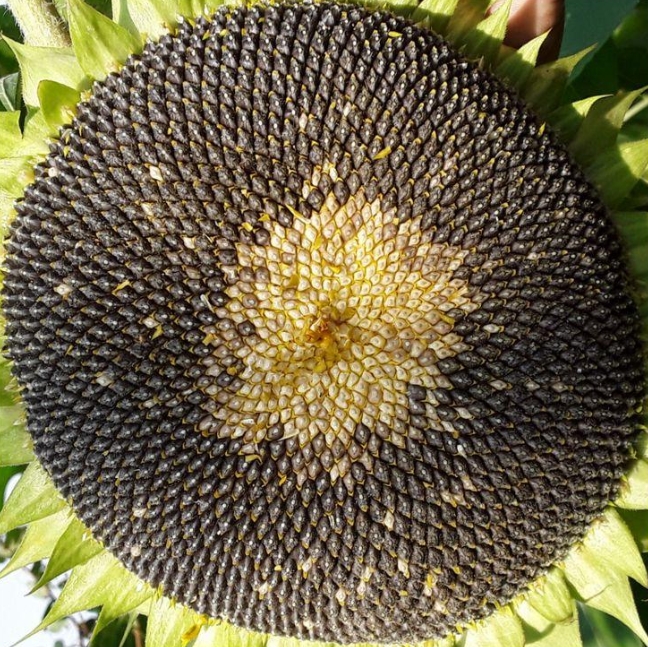
Thirteen also belongs to the Fibonacci sequence, in which each number is formed by adding the two preceding numbers: one, one, two, three, five, eight, thirteen, twenty-one, and onwards. These numerical relationships are reflected in some of Nature's most beautiful patterns, particularly the spiralling arrangements of seeds, petals and leaves. The sunflower offers a wonderful example, its seeds arranged in interweaving spirals that allow an extraordinary abundance of life to occupy a relatively small space.
These patterns have inspired generations of artists, mathematicians and seekers exploring sacred geometry, revealing relationships between form, proportion, growth and the natural world. Another symbolic expression of thirteen is twelve surrounding one, a central point held within a circle of twelve, an arrangement that invites us to contemplate the relationship between the individual and the whole.
For me, this image speaks to our own place within the greater web of Life, each of us a unique expression of existence, yet inseparable from the countless relationships that sustain us. The many becoming one, without losing the beauty of their diversity.
Thirteen also has associations with the Moon and the Goddess. A solar year contains approximately twelve and a third lunar cycles, rather than precisely thirteen, yet the number has become meaningful within contemporary lunar and Goddess-centred traditions, particularly those honouring the cyclical nature of existence.
The Moon offers us a constant reminder that fullness is not a permanent state. She waxes and wanes, disappears into darkness and returns, each phase belonging to the same unfolding cycle. We do not expect the Moon to remain full, nor the trees to hold their leaves throughout winter. We recognise the wisdom of changing seasons, the ebb and flow of tides, the rhythms of sleeping and waking, and the extraordinary processes of growth, decay and regeneration that sustain Life on Earth.
Yet within our own lives, we may struggle to accept these same natural movements, resisting change or fearing the uncertainty of what lies beyond the familiar. What might become possible if we were to deepen our trust in these rhythms, recognising that darkness and stillness have their place alongside light, growth and abundance?
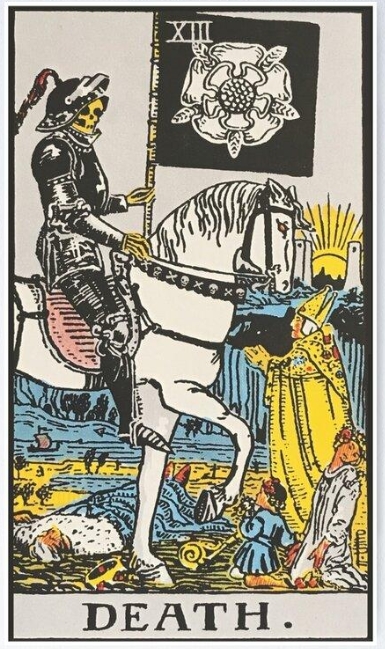
One of the most intriguing associations with thirteen is found in the tarot, where the thirteenth card of the Major Arcana is Death. In the familiar Rider–Waite–Smith deck, Death rides a pale horse, carrying a dark banner upon which a white rose blooms, whilst beyond the figures gathered before him, the Sun rises between two distant towers.
Despite its unsettling appearance, the card is traditionally understood to represent endings, transformation and renewal, rather than necessarily foretelling physical death. Its imagery invites us to contemplate the relationship between what passes away and what continues, between the dissolution of the familiar and the emergence of something yet unknown.
And here we find ourselves returning to Inanna, whose descent into the Great Below was no comfortable journey of self-improvement. She could not negotiate her passage through the seven gates whilst retaining the symbols of her earthly authority, nor could she simply decide to return when the experience became too difficult. She was required to encounter the Great Below on its own terms, surrendering everything that had once defined her place in the world.
There is a profound difference between attempting to control the processes of transformation and allowing ourselves to enter into relationship with them. Not every ending is of our choosing, nor does every loss bring an immediately recognisable gift. Yet the mystery of Life continues to unfold, even when we cannot see what lies ahead.
If thirteen carries such fascinating associations with Nature, the Goddess and the cycles of Life, how did it acquire its unfortunate reputation? There is no single, straightforward answer, although history offers some interesting clues.
In Christian tradition, thirteen became associated with the Last Supper, when Jesus gathered with his twelve apostles before his betrayal and Crucifixion. Friday itself acquired sombre associations as the day of the Crucifixion. Another event frequently connected with the superstition occurred on Friday 13 October 1307, when King Philip IV of France ordered the mass arrest of the Knights Templar, an influential religious and military order whose members faced accusations of heresy, imprisonment and persecution. Although the date is historically significant, there is little evidence that the persecution of the Templars gave rise to the superstition surrounding Friday the 13th, which became particularly prominent in European folklore much later.
But there is another aspect of this history that interests me. Throughout the centuries, political and religious institutions have exercised considerable authority over what people were encouraged to believe, which traditions were considered acceptable, and which practices were condemned or suppressed. The relationship between established religious authority and older spiritual traditions has been complex, sometimes involving adaptation and assimilation, and at other times persecution or rejection.
It could be misleading to suggest that the fear of thirteen was deliberately manufactured by a powerful elite seeking to conceal its sacred significance. The historical evidence does not establish such a conclusion. And yet, I believe it is important that we continue to question the extraordinary power held by those who shape our world: corporations, Big Pharma, banks, the industrial war machine and governments. Do they truly have our best interests at heart? Who has the authority to determine what is sacred, what is dangerous and what we should fear? And how often do we inherit beliefs without pausing to consider their origins?
Today, some hotels and office buildings still omit a thirteenth floor, airlines may avoid a thirteenth row, and popular culture continues to reinforce the association between Friday the 13th and misfortune. There is even a name for the fear of the number thirteen: triskaidekaphobia. How extraordinary that a number, which in itself possesses no capacity to bring good or bad fortune, can become so deeply embedded within our collective imagination.
Reclaiming thirteen need not mean exchanging one unquestioned belief for another. Rather, it offers an opportunity to cultivate our discernment, to remain curious, question what we have been told, and recognise that fear is not always a reliable guide to truth.
With Friday the 13th upon us, I rather like the idea of approaching the day as an opportunity for reflection, creativity and conscious intention. Cayelin Castell, whose exploration of thirteen inspired this blog, suggests creating a personal sigil, a symbol through which we give form and expression to our intentions.
Sigils have a long history within various magical traditions, where they have been used to represent spiritual forces, names or intentions. Today, they can also be approached as a creative and contemplative practice, bringing together imagination, symbolism and conscious attention. There is something rather lovely about creating a symbol that belongs entirely to us, without needing to follow someone else's prescribed interpretation.
Between Monday's New Moon and the Supermoon on Tuesday 24 November at 2.44pm, we find ourselves within a period considered by many to be particularly powerful for manifestation. Making the time to focus on what we long for and wish to bring into being can be a powerful practice in itself, whilst creating a sigil offers a beautiful way of amplifying those intentions, allowing ourselves the space to envision, imagine and plant the seeds of our desires.
And what do we long for? Health, vitality and joy? Abundance for our families and communities? Balance and sustainability for the Earth and the land that nourishes us? Clean water and enough food for all our human family? Our intentions need not be confined to our individual lives, but can reach outwards, embracing the wellbeing of our communities, the natural world and all the beings with whom we share this extraordinary home.
We might begin by finding a peaceful space, lighting a candle and taking thirteen slow, unhurried breaths, allowing ourselves to settle into the present moment. Listening to the sounds around us, the rhythm of our breathing and the sensations within our bodies, we can begin to consider an intention that feels meaningful, something we wish to nourish, honour or invite into our lives.
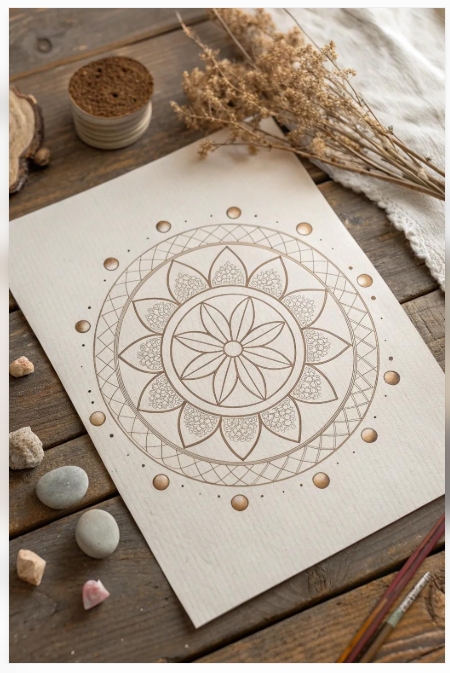
On a piece of paper, draw a circle and place your intention at its centre, perhaps as a word, an image, a colour or a symbol of your own making. Around this central circle, draw twelve smaller circles, allowing each to represent something that supports or gives expression to your intention. These might be qualities such as trust, courage, gratitude, love or patience, or simply shapes and marks that carry meaning beyond words.
There is no prescribed design and no right or wrong way to proceed. Allow your imagination and intuition to guide you, enjoying the process of creating something that is uniquely yours.
When your sigil feels complete, spend a little time contemplating what you have created. You might sound a singing bowl, ring a bell, sing a note or simply rest in silence, allowing your intention to settle within you.
And rather than holding tightly to a particular outcome, allow your creation to become a reminder of the relationship between your intentions, your actions and the greater unfolding of Life. Just as the seeds we plant require nourishment, patience and the right conditions to flourish, so too do the possibilities we wish to bring into being.
Through mythology, mathematics, astronomy and the human imagination, thirteen has gathered layers of meaning that reach far beyond its numerical value. Some of these associations are rooted in ancient traditions, whilst others have emerged through folklore and more contemporary spiritual interpretations. We need not confuse the two to appreciate the richness of what they offer.
As we approach Friday the 13th, I find myself returning to Inanna and her journey into the Great Below, to the courage of entering the unknown, the acceptance of what cannot be controlled, and the recognition that life and death, light and darkness, creation and dissolution are intimately woven together.
Throughout Nature, these cycles continue their extraordinary dance, reminding us that endings and beginnings are not always separate events, but part of the same unfolding mystery. And within our own lives, we too are participants in this continual process of becoming, each of us bringing our unique expression to the greater web of Life.
What if thirteen was never a number to fear, but an invitation to deepen our relationship with the mystery of Life itself?


